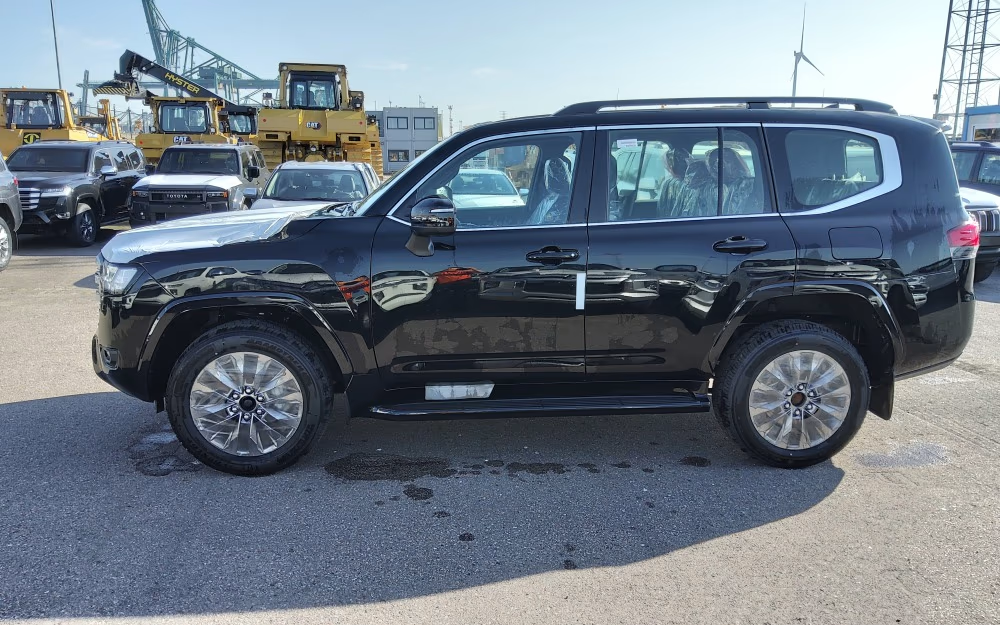
We get asked this question almost every day. And honestly, the answer isn't what most people expect. Here's our take, after years of exporting vehicles across the African continent.
When a client comes to us with the idea of importing a brand-new Euro 6 SUV to Senegal, Mali or the DRC, we don't say no straight away. We start with a simple question: is there an authorised dealer with proper diagnostic equipment within 200 km of where you'll be driving? In 80% of cases, the answer settles the debate.
Technically, a Euro 6 engine is a marvel. Lower fuel consumption, reduced emissions, solid performance. But that sophistication comes at a cost outside Europe: it demands clean fuel, a network of specialist garages, and parts that sometimes have to be shipped directly from Europe. When your DPF (diesel particulate filter) clogs up in the middle of the bush, that's not a mechanical problem — it's a logistical one. And it can leave you stranded for days.
We've seen clients come back with repatriation bills that exceeded the original purchase price. That's not an exaggeration.
It's not just a standard 4x4 with a "tropical" sticker slapped on it. Tropicalisation is a set of modifications designed for conditions that European engineers simply don't test for: 50°C in the shade, laterite tracks, high-sulphur local fuel, no tarmac for hundreds of kilometres.
In practice, that means an oversized radiator, reinforced air filters — often with a snorkel for river crossings or heavily dusty areas — a battery rated for extreme heat, and heavy-duty protection on the electrical wiring against moisture and corrosion. The chassis and suspension are also reworked to handle what African tracks throw at them. This isn't a luxury upgrade. It's basic mechanical survival.
If you're an expat based in Abidjan or Dakar, driving mainly on tarmac in the city, with access to a reliable maintenance network — a Euro 6 can absolutely work. The comfort, the technology, the driver assistance systems: there's a genuine difference in day-to-day driving, no question.
But if your use involves remote areas, degraded tracks, regions where fuel quality is inconsistent and garages are few and far between, then a tropicalised vehicle isn't just "the better choice" — it's the only sensible one. Mechanical robustness and local serviceability are worth far more than the latest onboard tech when you're 400 km from the nearest town.
Our position is clear: the longevity of a vehicle in Africa isn't measured by its features, but by its ability to still be running in 10 years with whatever resources are available locally. That's why at Transautomobile, we don't just sell a vehicle — we match the right vehicle to the client's actual use.
One last point we raise with almost every client: a well-maintained tropicalised 4x4 holds its value extremely well on local markets. Demand for reliable, easy-to-service, terrain-ready vehicles is strong — and it isn't slowing down. That's a financial argument worth considering, especially if you're thinking in terms of a medium-term investment.
And if you need parts that can't be sourced locally, our parts supply service can ship from Europe. Even with a tropicalised vehicle, it's a safety net that matters.
More than just a vehicle seller, Transautomobile has been offering top-notch service for over 50 years!
Contact us today to receive an offer tailored to your needs—or your desires.
info@transauto.be +3223520131




Would you like to receive our newsletter?
Enter your email and receive all our news and promotions!

 Hot deals
 4x4 & SUV
 Pick-up
 Luxury
 Electric
 Special
 Car
Car Minibus and bus
 RHD
RHD Trucks
 Machinery
 Generators
 Agricultural
 Parts
Parts Vans
Vans 360° view
 Videos


Top article, très instructif
Bonjour Stephan, c'est un plaisir de vous informer en continu ! Bonne continuation.
14-04-2025 - 04:28